
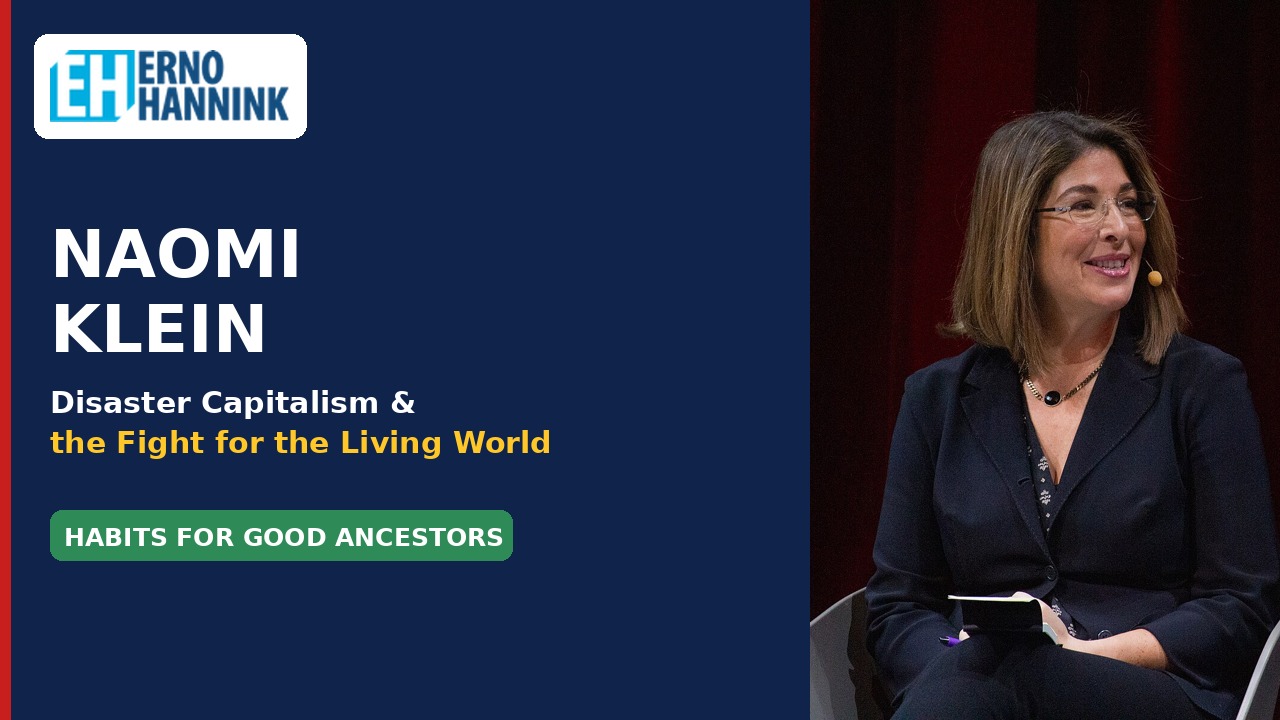
Every crisis arrives with two futures. One where the people who caused it get stronger. And one where we build something fairer. Naomi Klein has spent thirty years showing which one usually wins — and why.
The Shock Doctrine: the crisis as a crowbar
Her 2007 book documents the playbook. Wait for the crisis. Suspend the normal rules. Then push through the wish list you could never sell in calm times. Chile after the coup, Iraq after the invasion, New Orleans after Katrina. She called it disaster capitalism.
But the second half matters just as much. The shock is also an opening. What gets built inside that crack depends on who shows up with a plan.
What she puts against neoliberalism, consumerism and globalisation
Not nostalgia. Four concrete answers.
1. From extraction to regeneration. For Klein, extractivism is more than mining. It is a way of thinking that treats land, labour and people as a stock to be drained. The opposite is care for what is already there.
2. Blockadia. Change does not start in Brussels or Westminster. It starts where people live — next to the pipeline, the mine, the data centre. And the strongest barrier to extraction, she shows, is indigenous land rights: the most carbon-rich and biodiverse areas are on indigenous land, still protected by treaty rights.
3. The Leap Manifesto (2015). Written with Avi Lewis and Martin Lukacs after a summit with unions, indigenous nations and faith groups. Fifteen points: clean energy and community ownership, no new fossil infrastructure, retraining for workers, an end to forced spending cuts and fossil subsidies paid for by taxing wealth and profit, and democracy above trade treaties. Not less trade — more say.
4. No is not enough. Anger without an alternative always loses. So she describes a caring majority and a different definition of wealth: not more stuff, but time, care and security. Against consumerism she does not set austerity. She sets the commons — what belongs to all of us and is not for sale.
End Times Fascism: deny, confuse, then “it is too late”
Her tenth book, End Times Fascism: And the Fight for the Living World (September 2026), written with Astra Taylor, adds the final move. Denial, then funded confusion, then the conclusion that it is too late anyway — so let us consume what is left. Private islands. Rockets to Mars. Bunkered nations. Saving yourself while making the damage worse. Klein and Taylor call it the Armageddon complex: religious extremists, tech oligarchs and ethno-nationalists who agree on one thing — they are the ones who deserve to survive.
And the hopeful part, which they insist on: most people, including many who voted for these leaders, reject that story completely.
Her answer to the doom loop is hereness — doikayt, an old Jewish diasporic idea. Fight for justice where you actually are. Not as a retreat, but as the starting point of solidarity. It is also why she speaks out, as a Jewish public voice, against what is being done in Gaza. Solidarity is not a tribe. It is a practice.
Where she stops — and who continues
Be honest about what she does. She gives direction and a moral grammar. She shows with forensic precision where it goes wrong: who benefits, who pays, which story is being sold. What she does not give is the blueprint.
That is why her work sits next to thinkers like Kate Raworth and Katherine Trebeck. They draw the model: the doughnut, the wellbeing economy. Klein names the disease; they design the treatment. You need both, because diagnosis without design stays angry, and design without diagnosis stays naive.
The business lesson
A crisis is a fork in the road, not a verdict. The people who buy up the wreckage always arrive with a ready-made plan. So make yours before the crisis comes: write down what you will protect when things get hard — your people, your prices, your purpose. And ask the extractive question about your own company: what do I take from my people, my suppliers and my place, and what do I give back?
The habit
Once a week, do one thing within walking distance. Not because it solves everything, but because it keeps you rooted — and rooted people can act for others too.
Dream
Imagine an economy where a crisis is not an opportunity to extract, but to repair. Not everyone the same — but everyone with equal chances: development, care, education and food within reach. Protect what is close, and share what you have.
Sources
- Naomi Klein — official site, End Times Fascism: https://naomiklein.org/end-times-fascism/ (published 15 September 2026 with Astra Taylor; “Armageddon complex”; supremacist survivalism; majority rejects apocalyptic worldviews)
- The Guardian — review of End Times Fascism by Daniel Trilling (14 Sept 2026): https://www.theguardian.com/books/2026/sep/14/end-times-fascism-by-naomi-klein-and-astra-taylor-review-the-fightback-starts-here (“fascism is capitalism with bared teeth”; denial → confusion → doom; doikayt / hereness; “dismantle the concentration of wealth and power”)
- Wikipedia — Leap Manifesto: https://en.wikipedia.org/wiki/Leap_Manifesto (2015, Toronto; Klein, Avi Lewis, Martin Lukacs; collective drafting summit with labour, indigenous and faith organisations; the fifteen points including community-owned clean energy, moratorium on new fossil infrastructure, retraining, ending austerity and fossil subsidies funded by wealth and corporate taxation, moratorium on trade deals that infringe democratic rights)
- Wikipedia — This Changes Everything (2014): https://en.wikipedia.org/wiki/This_Changes_Everything_(book) (extractivism vs. regeneration; Blockadia; indigenous land rights as the major barrier to extractive industries; “Love Will Save This Place”; critique of green billionaires and geoengineering)
- Naomi Klein — No Is Not Enough (2017): https://naomiklein.org/no-is-not-enough/ (“no is not enough”; caring majority; bold alternative to shock politics)
- Wikipedia — Naomi Klein: https://en.wikipedia.org/wiki/Naomi_Klein
- Photo: Naomi Klein at Brainwash Festival 2017, by 1Veertje, CC BY-SA 4.0, via Wikimedia Commons — https://commons.wikimedia.org/wiki/File:Naomi_Klein_-_Brainwash_Festival_2017.jpg
Photo: Naomi Klein at Brainwash Festival 2017 — 1Veertje, CC BY-SA 4.0, Wikimedia Commons.

